Delays in Retail Leasing Linked to Communication Gaps
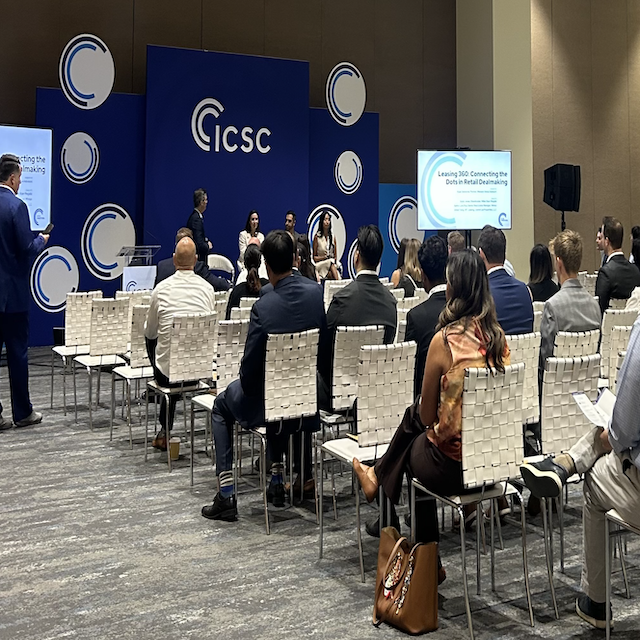
Deal timelines in retail real estate are stretching—but not necessarily for the obvious reasons, according to panelists at the ICSC@Western conference in Palm Springs. During the session, “Leasing 360: Connecting the Dots in Retail Dealmaking,” industry leaders parsed the factors slowing the pace of lease transactions and pointed to alignment, rather than market volatility alone, as a critical solution.
Moderator Ryan Desmond, Partner at Western Retail Advisors, guided the discussion among panelists with diverse sector vantage points. Grace Yang, Vice President of Leasing at CenterCal Properties, described changes to the traditional deal process. She noted that her team works deliberately to break down internal silos by looping in construction, legal, and finance from the moment a deal begins to take shape. “We trade NOIs with the tenant, and from there, construction reviews the work letter, legal reviews the language, and finance runs feasibility,” Yang said. “That way, by the time we’re at committee, we’ve already solved for cost, risk, and timeline.”
On the tenant side, Aaron Luna Ruiz, Senior Real Estate Manager at Miniso, acknowledged the increasing importance of operational efficiency in site selection, beyond traditional market and demographic analytics. “We’re always looking at where we already have a presence and where our customers want us to be,” he said. “But more than ever, it comes down to how quickly we can turn a space around. If the path of least resistance exists, that’s usually where the deal will get done.”
Legal issues are also extending deal timelines, particularly in deals involving new retail concepts or less institutional landlords. Katie Jones, Shareholder at Miller Starr Regalia, observed a trend toward more frequent and earlier involvement from legal counsel, sometimes beginning as early as the letter-of-intent phase. In her view, increased use of co-tenancy clauses and unique lease terms is prompting greater scrutiny at every stage.
Despite these varied perspectives, timing emerged as a shared concern among all three panelists. While rising construction costs and overlapping team priorities play a role, each speaker identified lack of internal alignment as the most persistent barrier to faster deals. Yang asserted that assembling all stakeholders—from tenant reps to attorneys to construction—at the outset makes the entire process run more smoothly. “No one wants to be the person holding up the deal,” she said.
Ruiz emphasized the significance of proactive follow-up. “What moves a deal forward now is follow-up,” he noted. “Being proactive. If you’re not doing that, someone else will be.”
Jones cited the pressures of overloaded inboxes and the tendency to let issues linger in email when a simple phone call would suffice. “We’re all busier than we’ve been in years, which is a great problem to have,” she said. “But it also means things get stuck in email threads that could be resolved in a five-minute call. Just talking to each other again could shave weeks off many deals.”
Ultimately, the panel’s discussion pointed to a clear takeaway: As market conditions remain unpredictable, improved coordination and communication are increasingly essential for efficient dealmaking in the retail leasing sector, according to the panelists.
Come back for more stories from this event.
First Impressions From My Attendance at ICSC@western
Source: GlobeSt/ALM